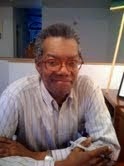
The following unpublished interview with the artist Armando Alleyne (born in 1959) was done in 1984.
Over a cup each of unsweetened peppermint tea, Armando Alleyne, an Afro-Latino artist, and I sat facing each other in his tiny studio apartment on Convent Avenue in Harlem. We discussed his work, travels, and ideas. On the walls were paintings and wood sculptures he had exhibited at two local art shows.
Alleyne also created three paintings for inclusion in the art collection at the Schomburg Center for Research in Black Culture of the New York Public Library system. "They're from the Cloud Series," he explained. "It is a series that deals with the sky and how it changes. They are abstract representations of the sky that would have other things blended into them." For example, continued Alleyne, one painting is "also a collage. There are stamp images of Martin Luther King stamped onto the sky. There are flowers and sometimes colors."
His gay artwork has appeared in the first and second issues of Blackheart, a black gay literary and graphic arts magazine, and in the New York Native, the gay weekly newspaper. In the summer of 1977, Fag Rag, published his poem, "Cute." Those publications no longer exist.
Portrait of Nina Simone by Armando Alleyne (The Jazz Series).
Alleyne, a graduate of the City College of New York, where he majored in painting, is of Puerto Rican/Barbadian heritage and is one of eleven children.
[Today, forty plus years later, Alleyne has received much recognition from the New York art world and has published A Few of My Favorites, a collection of artwork, photos, and poetry. The book was published in 2021 by the Swiss publisher, Edition Patrick Frey. Full disclosure: I was the book's proofreader.]
I asked him during the interview about his travels to other countries.
Armando Alleyne: I'm thinking of going to Mexico in January [1985] for a month or two to take some more lessons in ceramics. When I was in Africa, I was given a chance to study all these different wood sculptures. In Senegal I saw a lot of different wood carvings. I also went to Guinea-Bissau and Mauritania.
Charles Michael Smith: Did you feel connected to Africa in any way?
AA: Africa, I feel, has given me a more international scope of black people, to see Africans, first of all. It showed me there's always space for learning new things about different people and different cultures. I enjoyed it.
Militarily, over there, around certain army bases, governmental buildings, they get very touchy. They don't want you to take pictures of the governmental areas, like the capital buildings, the palace where the president of the country lives. They figured you might try to do a bomb plot and that's what you might use the pictures for. The same rule is also true in Guinea-Bissau. I can understand that. That's how they feel. I still enjoyed myself. I took pictures of a lot of things. I took pictures of the churches and of different people, fishing and farming. They basically lived off the land, either fishing or growing rice and plantains.
CMS: Where have you exhibited your work?
AA: I have already exhibited works from the Expectation Series at the Rainbow Studio Collective Anniversary Party art exhibit [June 16, 1984] and at the World Hispanic Fair [New York Coliseum, August 3, 4, and 5, 1984]. The exhibit had pieces from the Warrior Series and pieces from the Ancestral Series at that fair. It was a wonderful fair. There were 13, 14 artists altogether. They all had a sign saying the country that they were from. I had a sign saying "Nuyorican." I was going to put "Barbados" [on it] but they got into such a racket because they were saying Barbados is a British colony and "We don't want no British colony," quote unquote, "there." It doesn't matter to me. British or Spanish, it's the same colonial system.
CMS: The New York art world has, as you probably know, many gay artists in it.
AA: Yeah. I see myself as evolving in all different areas. I don't see necessarily the point of art only being placed in one particular area. I try to exhibit my art in whatever different areas I can. This is important because in a place like New York City, there are so many different audiences you can respond to and reach with your art.
The World Hispanic Fair was an excellent opportunity for me to share my work with other Latin artists as well as getting an aspect of all the different Latin countries performing and doing their thing and showing all the Indian-ness in their culture and the African-ness and the European-ness mixed into that culture.
Different people would come over. Some people would give donations because they were impressed. Other people would ask me questions like "Where did you learn your skills?," "How long did you study your art?" Some people there were saying that my work was very strong, really strong enough to continue doing what I was doing.
CMS: What are your future plans?
AA: What I want to do is make my own designs using stencil for sweatshirts and sell them in the fall. I really feel I could make a lot of money doing that. I have all the equipment ready for it. I have the dyes ready. It's the type of dye that when you put it on cotton, and once the picture is dry, you just have to iron it and it's permanent. Within the next three years I see myself doing sculptures for buildings, doing murals for buildings and corporations and family home units while still working on my prints and ceramic work. And all the time doing paintings, at home or in the studio. I visualize myself as having a house. Moving from a loft space to a house.