Showing posts with label Afro-Caribbeans. Show all posts

Thursday, June 12, 2025

A Nuyorican Artist Whose Art Is "Evolving In All Different Areas"

The following unpublished interview with the artist Armando Alleyne (born in 1959) was done in 1984.

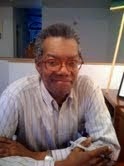
Over a cup each of unsweetened peppermint tea, Armando Alleyne, an Afro-Latino artist, and I sat facing each other in his tiny studio apartment on Convent Avenue in Harlem. We discussed his work, travels, and ideas. On the walls were paintings and wood sculptures he had exhibited at two local art shows.

Alleyne also created three paintings for inclusion in the art collection at the Schomburg Center for Research in Black Culture of the New York Public Library system. "They're from the Cloud Series," he explained. "It is a series that deals with the sky and how it changes. They are abstract representations of the sky that would have other things blended into them." For example, continued Alleyne, one painting is "also a collage. There are stamp images of Martin Luther King stamped onto the sky. There are flowers and sometimes colors."

His gay artwork has appeared in the first and second issues of Blackheart, a black gay literary and graphic arts magazine, and in the New York Native, the gay weekly newspaper. In the summer of 1977, Fag Rag, published his poem, "Cute." Those publications no longer exist.

                                                Portrait of Nina Simone by Armando Alleyne (The Jazz Series).
                                                 

Alleyne, a graduate of the City College of New York, where he majored in painting, is of Puerto Rican/Barbadian heritage and is one of eleven children.

[Today, forty plus years later, Alleyne has received much recognition from the New York art world and has published A Few of My Favorites, a collection of artwork, photos, and poetry. The book was published in 2021 by the Swiss publisher, Edition Patrick Frey. Full disclosure: I was the book's proofreader.]

I asked him during the interview about his travels to other countries.

Armando Alleyne: I'm thinking of going to Mexico in January [1985] for a month or two to take some more lessons in ceramics. When I was in Africa, I was given a chance to study all these different wood sculptures. In Senegal I saw a lot of different wood carvings. I also went to Guinea-Bissau and Mauritania.

Charles Michael Smith: Did you feel connected to Africa in any way?

AA: Africa, I feel, has given me a more international scope of  black people, to see Africans, first of all. It showed me there's always space for learning new things about different people and different cultures. I enjoyed it.

Militarily, over there, around certain army bases, governmental buildings, they get very touchy. They don't want you to take pictures of the governmental areas, like the capital buildings, the palace where the president of the country lives. They figured you might try to do a bomb plot and that's what you might use the pictures for. The same rule is also true in Guinea-Bissau. I can understand that. That's how they feel. I still enjoyed myself. I took pictures of a lot of things. I took pictures of the churches and of different people, fishing and farming.  They basically lived off the land, either fishing or growing rice and plantains.

CMS: Where have you exhibited your work?

AA: I have already exhibited works from the Expectation Series at the Rainbow Studio Collective Anniversary Party art exhibit [June 16, 1984] and at the World Hispanic Fair [New York Coliseum, August 3, 4, and 5, 1984]. The exhibit had pieces from the Warrior Series and pieces from the Ancestral Series at that fair. It was a wonderful fair. There were 13, 14 artists altogether. They all had a sign saying the country that they were from. I had a sign saying "Nuyorican." I was going to put "Barbados" [on it] but they got into such a racket because they were saying Barbados is a British colony and "We don't want no British colony," quote unquote, "there." It doesn't matter to me. British or Spanish, it's the same colonial system.

CMS: The New York art world has, as you probably know, many gay artists in it.

AA: Yeah. I see myself as evolving in all different areas. I don't see necessarily the point of art only being placed in one particular area. I try to exhibit my art in whatever different areas I can. This is important because in a place like New York City, there are so many different audiences you can respond to and reach with your art.

The World Hispanic Fair was an excellent opportunity for me to share my work with other Latin artists as well as getting an aspect of all the different Latin countries performing and doing their thing and showing all the Indian-ness in their culture and the African-ness and the European-ness mixed into that culture.

Different people would come over. Some people would give donations because they were impressed. Other people would ask me questions like "Where did you learn your skills?," "How long did you study your art?" Some people there were saying that my work was very strong, really strong enough to continue doing what I was doing.

CMS: What are your future plans?

AA: What I want to do is make my own designs using stencil for sweatshirts and sell them in the fall. I really feel I could make a lot of money doing that. I have all the equipment ready for it. I have the dyes ready. It's the type of dye that when you put it on cotton, and once the picture is dry, you just have to iron it and it's permanent. Within the next three years I see myself doing sculptures for buildings, doing murals for buildings and corporations and family home units while still working on my prints and ceramic work. And all the time doing paintings, at home or in the studio. I visualize myself as having a house. Moving from a loft space to a house.



Saturday, December 29, 2012

Pearl Primus, An Authority On African Dance

One of the greats in the black dance field who should be celebrated during Black History Month is Pearl Primus--dancer, choreographer, anthropologist , educator (she is professor of Ethnic Studies at Amherst College in Massachusetts). In the 1940s and '50s, Primus created such a stir with her African-based  dance works among critics and public alike that Walter Terry, the dance critic, now deceased, proclaimed her "the world's foremost authority on African dance."

That designation, resulting from her years of travel throughout the American South, the Caribbean, and Africa to study and document black dance, is anchored to her "search for roots" and her need to reveal "the dignity, beauty, and strength" of black people.


The 70-year-old Trinidadian-born artist-scholar's quest gave rise last summer to a photo-biographical exhibition at the Caribbean Cultural Center, "A Search for Roots: The Life and Work of Dr. Pearl Primus." The exhibition, part of the center's Third Annual Tribute to African Diaspora Women, consisted of many enlarged black and white performance photos from such dances as "The Negro Speaks of Rivers" (based on the Langston Hughes poem) and "Haitian Play Dance" as well as facsimiles of printed concert programs.


Pearl Primus, declared Dan Dawson, who curated the show, is a "living national treasure."

This article was submitted to the New York-based New American newspaper on January 30, 1990,but was not published.

Note: Pearl Primus died in 1994 at the age of 74.


Monday, November 26, 2012

Franklin A. Thomas: The First Black President Of The Ford Foundation

Franklin A. Thomas's selection as the seventh president of the Ford Foundation, the largest and richest foundation in the world (its assets total $3.4 billion) becomes especially significant when you consider the fact that Thomas, a successful lawyer, is a black man and was chosen from among more than 300 applicants. On June 1, 1979, he replaced McGeorge Bundy, who stepped down to retire. (Bundy became president in 1966. He had previously been national security advisor to Presidents John F. Kennedy and Lyndon B. Johnson).

"Frank Thomas's appointment," wrote Vernon Jordan in a 1979 syndicated column, "as head of a major bulwark of American institutional life heralds a new era of black inclusion, not only as soldiers in our society, but as generals commanding its heights."

Franklin Thomas, the youngest of six children, like many black Americans, began life in a working class neighborhood. In his particular case, the Bedford-Stuyvesant section of Brooklyn. His father, who died when Thomas was 11, worked as "a watchman down at the piers," said Thomas. "My mother [a native of Barbados] was a housekeeper; [she] cleaned people's houses, did day work."

As a public school student, Thomas was fortunate enough "to have some teachers who really saw some potential" in him. He also gives credit to his home atmosphere, especially to his mother who fostered the notion that "no one can determine what you're going to be but you and the only time you're damaged is when you let other people's assessment of you start to control your assessment of self. If you're honest and you work hard and you're reasonably smart and [you] get along well with people, you're going to have a good life. That's really what all of this is about. A good life, a decent life. Not hurt other people."

"I never knew any sense of limitation," continued Thomas. "I always worked hard, worked after school, joined the Boy Scouts at the age of 11. You didn't think of yourself as [being] extraordinary. Some guys chose to be on a street corner, hanging out and knocking other people in the head; other guys were on the street corners but you didn't think about trying to rip anybody else off and you knew which blocks were safe to go down, which ones weren't. You built a capacity to survive in an environment that on the one hand is menacing and at the same time is supportive because there are others just like you."

Because of Thomas's athletic ability (he was the captain and star of his high school basketball team), he was offered numerous athletic scholarships. He turned them down and enrolled instead at Columbia University, becoming the first member of his family ever to go to college. "I had a coach and teachers in high school who said 'Don't accept an athletic scholarship. Your grades are good enough to get [you] into the college you want on academic grounds. Then if you want to play basketball, you can. But you're not obliged to play it.' So I got a scholarship based on need rather than an academic scholarship and had a great time. I ended up playing basketball for four years anyway." In 1956 he received his B. A. degree.

After four years in the air force, he went to law school at Columbia, graduating in 1963 with an LL.B degree. A year later, Thomas was admitted to the New York state bar. "My first job was in the housing field [Federal Housing and Finance Agency], working in urban renewal."

Other jobs that followed were: Assistant U.S. Attorney for the Southern District of New York [Manhattan] (1964); deputy police commissioner for legal matters, New York Police Department (1965); and president and chief executive officer of the Bedford-Stuyvesant Restoration Corporation (1967). "After the [urban] riots [in 1964], Senator [Robert] Kennedy and others had the idea of a development effort in the second largest black community in the country, Bedford-Stuyvesant, and asked me if I would leave my job [at the police department] to help organize it and get it started. After a lot of back and forth, I agreed to do it for two years; I stayed ten years. Then I went back and practiced law for a little while" before accepting the $120,000-a- year top job at the Ford Foundation.

Thomas also sits on the board of directors of such corporate giants as CBS, the Aluminum Corporation of America (Alcoa), and the New York Life Insurance Company. He is the only black person sitting on Citigroup's 26-member board of directors and, according to Current Biography (October 1981), "was instrumental in persuading that company to end its loans to the white supremacist government of South Africa."

Thomas, who has been divorced since 1972, has four children. Since he, at the age of 49, can no longer play basketball, he has tried to learn tennis. Once or twice during the winter he skis but, he is quick to point out, "on intermediate slopes, not on too tough slopes."

Despite the enormous responsibilities as head of the foundation, he tries not to take himself too seriously. And he continues to work 12-hour days, just as he did at the Bedford-Stuyvesant Restoration Corporation.

The following interview took place in Thomas's office at the Ford Foundation.

Charles Michael Smith: Has the Ford Foundation increased or decreased its funding for inner city programs?
Franklin Thomas: The foundation has increased its support for inner city poverty-related programs in each of the last four years and we look forward to an increase for the upcoming two-year period.

CMS: What programs are receiving financial assistance from Ford?
FT: The largest of the five major program areas the foundation supports is an area called urban poverty and that concentrates on the problems of housing and social and economic revitalization within the inner cities where large concentrations of poor people live and that effort involves supporting organizations that are trying to improve the living conditions in those areas. These organizations are usually called community development corporations.

CMS: Is volunteerism a viable solution to socio-economic problems?
FT: By itself, it is not a solution. It must be combined with commitments from each of the levels of government and a commitment through the private-for- profit sector. When combined with those commitments, volunteerism is a dynamic, critically important part of our strategy as a nation for dealing with some social problems.

CMS: What criteria do you use when you select an organization for a grant?
FT: We try to define problems on which we're going to work or support work in. We try to do that with sufficient clarity so that a prospective grantee can ask, 'Are you interested in these kinds of problems?' If the answer is yes, then we would encourage that person, group to submit a description of what it is they plan to do about an aspect of the problem. We then sit and go over that as a staff, decide if it seems to make sense, [see] if the apparent capability to carry it out is there, and if the answer to those questions is yes, then we would invite the prospective grantee in and have a discussion with them, and make a decision.

CMS: Do grantees come to you or do you come to them?
FT: We do both.

CMS: If I came to you as an individual with a program, I wouldn't necessarily have to be part of a group?
FT: You wouldn't have to, though the overwhelming share of our money goes to organizations that have a plan and a strategy. We do make some grants to individuals. Usually for study, research, what have you. But almost anything you want to carry out in an operational sense will require some institutional context within which to function. If you want to do something about housing beyond a study or a survey which you can do as an individual but you want to cause some change to happen there, then the odds are you're going to have to find some institutional way to bring that about.

CMS: Do Ford Foundation funds go to anti-poverty projects overseas?
FT: We spend roughly a third of our funds overseas in what we call developing countries. We have nine offices around the world.

CMS: Do you see inner city areas improving because of Ford Foundation money?
FT: That's the toughest question of all.  How do you measure impact? My personal answer is yes, I see improvement. It's slower and less pervasive than any of us would like but it's clearly better than it would have been were these resources not being employed in the way they are and have been employed. I think I can answer that with certainty. The tougher question is "Is it enough?" The answer there is no and if not, then what the hell do you do about it? That's the continuing struggle.

CMS: Do you feel you have a special responsibility to the black community in your present position?
FT: It's a continuation of a concern and an interest and a relationship that really has been a part of my life. So I don't think of them as special. I just think of them as natural. They are with me as a part of what I am.
I also recognize the obligation to the total problem of trying to reduce or eliminate poverty and injustice and worry about peace and security matters, worry about international economic matters, worry about refugees and migration matters, worry about higher education, each of which has an impact on minorities, if you will, worldwide. And perhaps, just based on the experience of living in and working in some minority communities in this country, you get a particular sensitivity on not only what is needed, but on the means of assisting that are most likely to be effective.


This condensed article was originally published in two parts in the Harlem Weekly newspaper in 1984.

Saturday, October 13, 2012

Choreographer Garth Fagan, An Artist Who Happens To Be Black

Reading through the dance reviews about Garth Fagan's Bucket Dance Theatre, you come across such comments as "And though most of the dancers are black, the movement is in no way ethnic" (San Diego Union). After awhile you begin to wonder if that's why the white critics are so enthralled with Fagan's choreography. (Although it's hard to see how the Union critic came to his conclusion, since a dance like "Time After Before Place" has an unmistakable Caribbean motif, including the carnivalesque costumes.)

I saw the Bucket Dance Theatre perform at the Joyce Theatre during the first week of a two-week engagement (their run ends November 13 [1988].) And though I acknowledged the skill of the dancers and the intricacy of the choreography put on them by Fagan, these gymnastic feats left me virtually unmoved. In fact, the audience that night showed more enthusiasm than I did. At the root of my attitude is the fact that Fagan, to quote the critic from San Diego, "never imposes ideas and issues upon the dance material." My preference is for dance-drama, not abstract movement.

Strangely, Fagan, a native of Jamaica, with roots in Afro-Caribbean dance (as a teenager he danced with the Jamaican National Dance Theatre) told the Los Angeles Times critic that he prefers to be known as "an artist who happens to be black." But then again, maybe it isn't so strange. Langston Hughes, in his famous 1926 essay, "The Negro and the Racial Mountain," spoke about a young black poet who told Hughes that he wanted to be known as "a poet--not a Negro poet." Hughes warned us against those artists who harbor "the desire to pour racial individuality into the mold of American standardization, and to be as little Negro and as much American as possible."

That's why I have a tremendous amount of respect and affection for Kevin Jeff and his [Brooklyn-based] Jubilation! Dance Company. They make no apology for who and what they are. I just wish other dancers and choreographers felt the same way.

This item, which appeared in a dance column I wrote for the New York Amsterdam News, was published January 28, 1989.

Wednesday, October 10, 2012

African Influence In The Americas

Since its inception in 1976, the Caribbean Cultural Center in Manhattan, along with numerous other black institutions, has been continuing the battle against the centuries-old myth that blacks have had nothing of value culturally or intellectually to offer the New World. The center has been doing this by researching and identifying African continuities and retentions, and showing their impact on general society.

The center, the brainchild of Marta Moreno Vega, a New York-born Puerto Rican and its executive director, grew out of a Rockefeller Foundation fellowship she received in 1975 to find out about various art collections that had been properly identified, as well as find out their location. At that time, Ms. Vega, a former art education teacher in the New York City public school system, was director of El Museo del Barrio in East Harlem and needed the information in order for the art objects to "make any sense."

She had no intention of starting an institution when she got the first of two six-month fellowships. But her difficulties in tracking down and identifying collections made it clear that a center was needed to make these publicly inaccessible artworks available for scholarly examination. It became necessary for her to travel throughout the Caribbean and Bahia, Brazil to see what other institutions were doing so that she could decide what she would do differently. She learned that local institutions focused only on the history and culture of their particular geographic area and that "[n]one of them brought the cultures together and explored their relationship and commonalities and their differences."

It became apparent to Ms. Vega that such a center would be a unique cultural treasure chest to scholars and laymen alike. As it turned out, scholars and researchers were very receptive to the idea because, she said, they "felt there had to be some kind of institutional vehicle that would bring this information to the foreground."

When she was asked how strong the African influence in the Americas has been, Ms. Vega replied: "It's pervasive. You see it in terms of instruments in orchestras, in terms of clothing style, in terms of foods. The Afro-American community is clearly becoming the majority culture. When you have a majority culture, you  have food, clothes, art forms that are expressive of [that] culture. We have to be very clear that the influence and impact is there." Although the African cultural influence in the Americas is "very much intact," she continued, "the media doesn't focus on it and when [the media] does [they present this influence as coming from] primitive cultures. And derogatory terms makes us turn away [from that influence] or say it's not there."

The Caribbean Cultural Center, newly located in a narrow, four-story building near St. Luke's-Roosevelt Hospital on the West Side of Manhattan receives about 60 to 65 people a day. The support and attendance from the black community, said Ms. Vega, "has been very good. We get increasingly more pleased, more committed to what we're doing because the audience represents black people from all cultures."

The center plans to have an enclosed tropical garden in the backyard so that children can see the various kinds of "plants and vegetation that grows in the Caribbean." Also planned is the completion of fourth-floor remodeling work. This is where all audio-visual documentation of center activities will be made accessible to students and researchers.

When storage space for the audio-visual materials runs out, the center will donate to the New York Public Library's Schomburg Collection or some other library those materials no longer needed.

According to Ms. Vega, the center has developed a five-year plan and is "looking for those kinds of activities and art forms that [will] fit into the development of that plan," a sort of blueprint detailing the center's direction and aesthetic definition. She pointed out that in the search for "the broader impact of African cultures in the Americas," they would like to "move into Panama and Colombia and other areas where black continuities are."

This article was originally published in the Harlem Weekly newspaper in 1983.

Note: The Caribbean Cultural Center, in 2012 or 2013, plans to leave its 58th Street location and move to its new home, an abandoned firehouse on 125th Street in East Harlem, just steps from the Metro North and Lexington Avenue train stations.

Tuesday, July 3, 2012

A Triple Heritage

The Voice of the People
New York Daily News
220 East 42nd Street
New York, NY 10017

December 7, 1992

Dear Editor:

Voicer Nick Arroyo (December 5, 1991) believes blacks from the Caribbean islands, who now live in Crown Heights [Brooklyn], should not be called African-Americans, but Caribbean-Americans. What he forgets is that their ancestral home is Africa, too. They should be called instead, however unwieldy on the tongue, Afro-Caribbean-Americans. This would remind people of this group's triple heritage.

Sincerely yours,
Charles Michael Smith

This letter was published in the New York Daily News on December 26, 1992.