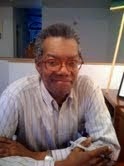
At the age of 26, Yves Francois Lubin, known in the theatre as Assotto Saint, is a man blessed with many artistic gifts. He writes plays or what he prefers to call "theatre pieces," sculpts, paints, dances, and sings.
It's his belief that "art can transform people," that "art has to be political...that the artist has to be an activist, politician, preacher."
He has written, thus far, three plays. One of them, Risin' to the Love We Need was reviewed by the Amsterdam News critic Lionel Mitchell. "This is a play," wrote Mitchell, "about black gay men and aside from its obvious roughness, it pulls no punches." Another critic, Robert Chesley of the New York Native, had this to say: Lubin "uses language that is frequently very beautiful, and there are some very moving moments in the play."
Lubin came to this country in 1970 with his mother from his native Haiti. He is the product of a well-educated, upper middle class family. While his mother was living in Europe, Lubin was being raised by his grandparents and aunts. "From a very early age,"he says, "I liked boys. I was surrounded by macho men all over and nobody tried to change me.I don't know why. I have so many cousins. About 25, 26 cousins, and we used to play together. I used to always be the bride. I always wanted it. I give my family credit that they let me become who I was. [His family may have been tolerant of his effeminacy, but neighborhood kids were not. They would often call him "massici," the Creole word for "sissy." Even today, Lubin admits to having "effeminate ways."]
Lubin is light-skinned, has a small, well-trimmed mustache, and wears his hair moderately short. Despite his 13 years in America, he still speaks with a heavy Haitian accent.
Charles Michael Smith: You call your plays theatre pieces. What is the difference?
Yves Francois Lubin: They don't necessarily have a beginning, middle or ending. They don't have to have a structure. They're broader.
CMS: Do all of your plays--or theatre pieces--deal with being gay?
YFL: Especially with being black and gay in America in 1983. Certain people in my family felt I was limiting my talent to work only with gay art.
CMS: Do you write for a specific audience?
YFL: I write for everybody. I deal with black gay issues because my art right now is an answer back. It's a reaction. The world is still fucked up and why not have it coming from a different perspective and see it from there?
CMS: What do you draw on for your characters?
YFL: From my fantasies, from people I've known. Mostly all my characters are composites of friends. My "Miss Thing" [an excerpt from Risin', published in Blackheart 1: Yemonja] was definitely based on a real person, Marcia Johnson, a [black] transvestite who used to be very active in the gay movement.
CMS: What writers influenced you?
YFL: James Baldwin used to be a big influence in my life. Pablo Neruda nurtured me, really nurtured me. Anne Sexton also. I'm one of those confessional [writers], letting it all out there, bleeding, very melodramatic. I wish I could restrain myself. I'm one of those people who are sometimes too open for their own good. Sometimes you have to leave a little bit for the imagination, a little bit for suspense.
One of the things I realize, especially from gay writers, is that we have to stop dealing with cock and cocksucking and deal with other issues that may not be fashionable for gay writers to deal with, like the nuclear issue. People feel that when a black leader like Jesse Jackson speaks, he has to deal only with civil rights. Bullshit. You're a human being, you're living in 1983, in the United States. You're paying taxes. You should involve yourself in all kinds of issues.
CMS: I am told that Haiti is a playground for American gay men. How much difference is there between Haitian gay life and American gay life?
YFL: It's night and day. Most Haitians you see who are gay in Haiti are prostitutes, though there is a Haitian gay life. There are celebrated artists who are gay. But gays have no power in Haiti--although I've been told that there are a few highly positioned gays in this present [Baby Doc's] government. I don't know. Whenever I go to Haiti, I go there to relax and to just lay down from all that's happening in New York.
If you're an American going to Haiti, you will not have problems. But if you're gay [and Haitian] in Haiti, you will have problems. American money is being sold in Haiti. Being an American is being a god; it means money. You can do whatever you want, whether you're gay or not. But if you're gay and Haitian, that's different: there's homophobia you have to deal with. You're a pariah in that society.
This article is an excerpt from an interview that was published in the New York Native in 1984. The interview took place in his apartment in the Chelsea section of Manhattan.
Showing posts with label Gay Theatre. Show all posts
Showing posts with label Gay Theatre. Show all posts
Wednesday, January 23, 2013

Monday, December 17, 2012
An Underground Hideaway
Now that the AIDS epidemic has entered its second decade, more and more plays like Michael Fife's The Hideaway Hilton, will appear on Off Broadway and Off Off Broadway stages to explore the worrisome issues of internment and quarantine.
In The Hideaway Hilton, which ran for three weeks at the Theatre of 224 Waverly Place (Greenwich Village), six characters have hidden in an underground bomb shelter to escape the intensive roundup by the authorities of all those infected with an unnamed disease (probably AIDS, to judge by the symptoms alluded to).
With an ear always to the door for the dreaded knock that never comes, the characters--a male escort of rich old ladies, a yuppie couple, a gay man from the Deep South, a lesbian hack writer, and a young woman (under whose house the bomb shelter is located)--while away the monotonous, fearful days underground playing board games and movie trivia, revealing their most intimate secrets, and fighting (verbally and physically) with each other.
The play would have been more poignant had there been more of a gloom-and-doom ambiance and less campiness, particularly from Fife, whose voice and mannerisms bespoke a gay man rather than a fabulously gorgeous hunk who swept women off their feet.
This article was originally published in the New York Amsterdam News (November 21, 1991).
In The Hideaway Hilton, which ran for three weeks at the Theatre of 224 Waverly Place (Greenwich Village), six characters have hidden in an underground bomb shelter to escape the intensive roundup by the authorities of all those infected with an unnamed disease (probably AIDS, to judge by the symptoms alluded to).
With an ear always to the door for the dreaded knock that never comes, the characters--a male escort of rich old ladies, a yuppie couple, a gay man from the Deep South, a lesbian hack writer, and a young woman (under whose house the bomb shelter is located)--while away the monotonous, fearful days underground playing board games and movie trivia, revealing their most intimate secrets, and fighting (verbally and physically) with each other.
The play would have been more poignant had there been more of a gloom-and-doom ambiance and less campiness, particularly from Fife, whose voice and mannerisms bespoke a gay man rather than a fabulously gorgeous hunk who swept women off their feet.
This article was originally published in the New York Amsterdam News (November 21, 1991).
Saturday, December 15, 2012
A Play's Exploration Of Four Thorny Issues
True to its title, Face to Face, a two-act play which ran recently at the National Black Theatre in Harlem (in association with the Brooklyn-based Rainbow Repertory Theatre), bravely confronted four thorny issues within the African-American community: homosexuality, color-consciousness, sexism, and class, with a generous amount of humor thrown in to ease the tension.
The action of the play takes place entirely in the inner city Washington, D.C. home that Neal (Jeff A. Haskins), a black nationalist undergrad at Howard University, shares with Marcus (Raan Lewis), a religious homeboy.
When Neal's brother Sammy (Bryan Webster), who is about to graduate from Notre Dame, calls him from the airport to announce his arrival in town, Neal rebuffs his request to stop by. It's clear there is no love lost. One cause of the tension is Sammy's "theft" of Neal's girlfriend Hillary. Another source of tension is Sammy's reputation as the "boy wonder" of the family.
While waiting for Neal to come home, Sammy meets Marcus. They instantly take a dislike to each other because of class differences. When Catherine (Tia Sinclair), a light-skinned classmate of Neal and Marcus, enters the picture, she accepts Sammy's invitation to dinner. Neal hits the roof when he learns he has lost another girl to Sammy. After he finds some love letters in Sammy's bag addressed to a guy named Tim, he sees his chance for revenge.
During the confrontation with Neal, Sammy gets his second attack of stomach pains (AIDS-related?) which forces Neal to regard his brother with more sympathy. That sudden change of heart I found unbelievable, especially since the brothers, Neal in particular, have such deeply rooted animosity toward each other.
Near the end of the play, Sammy, with suitcase in hand, prepares to catch his flight back to Notre Dame. Before he can set foot outside the door, he and Marcus come face to face again. This time the confrontation has a murderous result when Marcus, a closet queen, discovers his true feelings for Sammy.
Although Bryan Webster's acting is a little wooden and he and Jeff Haskins look too old to be undergrads, you'll be too involved in the swiftly moving story to care, especially when Raan Lewis, a truly gifted actor, is on the stage.
This article was originally published in the New York Amsterdam News (November 21, 1991).
The action of the play takes place entirely in the inner city Washington, D.C. home that Neal (Jeff A. Haskins), a black nationalist undergrad at Howard University, shares with Marcus (Raan Lewis), a religious homeboy.
When Neal's brother Sammy (Bryan Webster), who is about to graduate from Notre Dame, calls him from the airport to announce his arrival in town, Neal rebuffs his request to stop by. It's clear there is no love lost. One cause of the tension is Sammy's "theft" of Neal's girlfriend Hillary. Another source of tension is Sammy's reputation as the "boy wonder" of the family.
While waiting for Neal to come home, Sammy meets Marcus. They instantly take a dislike to each other because of class differences. When Catherine (Tia Sinclair), a light-skinned classmate of Neal and Marcus, enters the picture, she accepts Sammy's invitation to dinner. Neal hits the roof when he learns he has lost another girl to Sammy. After he finds some love letters in Sammy's bag addressed to a guy named Tim, he sees his chance for revenge.
During the confrontation with Neal, Sammy gets his second attack of stomach pains (AIDS-related?) which forces Neal to regard his brother with more sympathy. That sudden change of heart I found unbelievable, especially since the brothers, Neal in particular, have such deeply rooted animosity toward each other.
Near the end of the play, Sammy, with suitcase in hand, prepares to catch his flight back to Notre Dame. Before he can set foot outside the door, he and Marcus come face to face again. This time the confrontation has a murderous result when Marcus, a closet queen, discovers his true feelings for Sammy.
Although Bryan Webster's acting is a little wooden and he and Jeff Haskins look too old to be undergrads, you'll be too involved in the swiftly moving story to care, especially when Raan Lewis, a truly gifted actor, is on the stage.
This article was originally published in the New York Amsterdam News (November 21, 1991).
Monday, November 26, 2012
Two Gay Plays In Brooklyn
The newly-founded Rainbow Repertory Theatre proudly bills itself as a company whose aim is to develop and promote the plays of gay and lesbian playwrights of color. However, its artistic director Reginald Jackson, himself a playwright, does not "want to just appeal to the gay community."
In fact, Rainbow Rep's first offerings--Kids and Enormous Insignificancies (both directed by Jackson)--have more straight characters in them than gay. "We [as gay people] really don't live in a vacuum," explained Jackson, "so I don't see any purpose in doing pieces in a vacuum."
Both one-act plays will be presented back to back March 6 and 13[1988], starting at 7 p.m., at the Alonzo Players Theatre, 317 Clermont Avenue, Brooklyn, under the umbrella title: "Kuumba: A Night of New Theatre." (Kuumba means "creativity" in Swahili.)
Kids, a play with music by Charles Pouncy, deals with self-identity and self-acceptance. The focus is on two adolescent brothers--Jacob, who is openly gay to the point of being effeminate and David, who, when confronted by his mother, denies his homosexuality. "This would be a wonderful piece for gay and lesbian youth of color to come to," said the 24-year-old director, a native of Queens, "because Kids is about them. It's about me, too. I've lived it. But they're living it now. They've got no sense of validation."
While Kids, with its musical soliloquies and humorous touches, can be quite entertaining, its companion piece, Enormous Insignificancies by Hector Lugo, about a Puerto Rican playwright dying of AIDS, can be very unsettling. "What do you want me to do," asks Gaston, the playwright (played by Lugo), as he lay on a psychiatric couch, "go up to this man, the only human being who has been kind to me, who I love, and say I've got--I'm going to die and maybe you've got it, too? I can't, I can't, I can't."
Enormous Insignificancies, recalled Jackson, "was originally done at City College for the one-act festival last year. I didn't see it, but I knew Hector. We were at the college together. [After reading the script], I told him if he was interested in rewriting it, I would consider doing it."
Although the playwrights involved with Rainbow Rep must be gay or lesbian, that rule does not apply when Jackson goes about the task of selecting the cast. "There are 11 people in the total production--five gays and six straights, at least that is their public image. I'm not going to pull people who are in the closet, out of the closet. My political stance is that I don't particularly condone being in the closet, but artistically it's irrelevant. As far as I'm concerned, the actors are asexual on stage. The audience shouldn't be trying to figure out who's gay and who's straight. That defeats the purpose."
A future project waiting in the wings is "a theatrical dialogue" between gay men and lesbians. "It'll be two different pieces," said Jackson,"running about 45 minutes each, comprised of poetry and prose exploring how we feel about each other, what are the myths, the stereotypes, the misconceptions, the questions, the fears that affect the whole relationship. I've got ideas on what I think will probably come up in it, but I have no idea what the overall gist or structure will be." That would be left up to the poets and playwrights "who would get together on a Saturday or a Sunday for three hours, four hours," continued Jackson, and "brainstorm" on how they would "create the written work into a theatre piece; linking the pieces and building a script."
This article was originally published in the Philadelphia Gay News (March 11, 1988).
In fact, Rainbow Rep's first offerings--Kids and Enormous Insignificancies (both directed by Jackson)--have more straight characters in them than gay. "We [as gay people] really don't live in a vacuum," explained Jackson, "so I don't see any purpose in doing pieces in a vacuum."
Both one-act plays will be presented back to back March 6 and 13[1988], starting at 7 p.m., at the Alonzo Players Theatre, 317 Clermont Avenue, Brooklyn, under the umbrella title: "Kuumba: A Night of New Theatre." (Kuumba means "creativity" in Swahili.)
Kids, a play with music by Charles Pouncy, deals with self-identity and self-acceptance. The focus is on two adolescent brothers--Jacob, who is openly gay to the point of being effeminate and David, who, when confronted by his mother, denies his homosexuality. "This would be a wonderful piece for gay and lesbian youth of color to come to," said the 24-year-old director, a native of Queens, "because Kids is about them. It's about me, too. I've lived it. But they're living it now. They've got no sense of validation."
While Kids, with its musical soliloquies and humorous touches, can be quite entertaining, its companion piece, Enormous Insignificancies by Hector Lugo, about a Puerto Rican playwright dying of AIDS, can be very unsettling. "What do you want me to do," asks Gaston, the playwright (played by Lugo), as he lay on a psychiatric couch, "go up to this man, the only human being who has been kind to me, who I love, and say I've got--I'm going to die and maybe you've got it, too? I can't, I can't, I can't."
Enormous Insignificancies, recalled Jackson, "was originally done at City College for the one-act festival last year. I didn't see it, but I knew Hector. We were at the college together. [After reading the script], I told him if he was interested in rewriting it, I would consider doing it."
Although the playwrights involved with Rainbow Rep must be gay or lesbian, that rule does not apply when Jackson goes about the task of selecting the cast. "There are 11 people in the total production--five gays and six straights, at least that is their public image. I'm not going to pull people who are in the closet, out of the closet. My political stance is that I don't particularly condone being in the closet, but artistically it's irrelevant. As far as I'm concerned, the actors are asexual on stage. The audience shouldn't be trying to figure out who's gay and who's straight. That defeats the purpose."
A future project waiting in the wings is "a theatrical dialogue" between gay men and lesbians. "It'll be two different pieces," said Jackson,"running about 45 minutes each, comprised of poetry and prose exploring how we feel about each other, what are the myths, the stereotypes, the misconceptions, the questions, the fears that affect the whole relationship. I've got ideas on what I think will probably come up in it, but I have no idea what the overall gist or structure will be." That would be left up to the poets and playwrights "who would get together on a Saturday or a Sunday for three hours, four hours," continued Jackson, and "brainstorm" on how they would "create the written work into a theatre piece; linking the pieces and building a script."
This article was originally published in the Philadelphia Gay News (March 11, 1988).
Wednesday, October 24, 2012
"Growing Up, Out, And Powerful": An Excuse To Rant
Alternating between militancy and humor, Growing Up, Out and Powerful is a semi-improvisational, autobiographical theatre piece. "[Its intent is] to detail and dramatize the process of becoming a sane, healthy, lesbian/gay, progressive person of color in a world that tends to be otherwise," said John Patterson, the director.
Through poetry, songs, monologues, and discussion, the five performers (Patterson, Colin Robinson, Pam Lewis, Nestor Millan, and Lourdes Perez) attempt to fulfill that promise.
It runs through June 27 [1987] at the Castillo Cultural Center, 7 East 20th Street, in Manhattan, in six evening performances. Each of those shows spotlights different guest poets, and is part of an overall celebration of Gay Pride Month.
Of the five, Patterson was the only experienced actor, which was obvious--he was the one who gave an unstilted, self-confident, and joyful performance.
Surrounded by the audience on three sides, Patterson and company occupied a sparsely furnished set that represented, said the press release, a living room in a railroad flat. Frankly, I couldn't tell where it was supposed to be.
Initially, the dialogue was lively and humorous as they exchanged reminiscences about being black or Latino homosexual adolescents. After about the first 20 minutes, the show began to go downhill. With the exception of Patterson, the autobiographies began to ramble; nothing significant was said. Other problems I found annoying were Nestor Millan's heavily accented English which made it hard to understand him and Pam Lewis's soapbox histrionics. In addition, the show ran close to three hours, with no intermission. It should have been cut to 90 minutes, have as its main focus the lives of three people, not five, and have a more cohesive structure.
As for the special guests--poets Cheryl Clarke and Jewelle Gomez, on the night that I attended--they should not have been isolated in a separate segment but integrated among the regular cast members in a five-minute cameo appearance. In so doing, they would have been given the chance to share a few lines of poetry as well as some thoughts in a manner that would not have destroyed the theatre piece's continuity.
It became apparent to me that Growing Up, Out, and Powerful was an excuse to put forth political ideas endorsed by the New Alliance Party, the left-leaning group that runs the Castillo Cultural Center. But then again, that fact should come as no surprise to anyone familiar with NAP and their tactics.
This article was submitted to the New York Amsterdam News on June 19, 1987. It was not published.
Through poetry, songs, monologues, and discussion, the five performers (Patterson, Colin Robinson, Pam Lewis, Nestor Millan, and Lourdes Perez) attempt to fulfill that promise.
It runs through June 27 [1987] at the Castillo Cultural Center, 7 East 20th Street, in Manhattan, in six evening performances. Each of those shows spotlights different guest poets, and is part of an overall celebration of Gay Pride Month.
Of the five, Patterson was the only experienced actor, which was obvious--he was the one who gave an unstilted, self-confident, and joyful performance.
Surrounded by the audience on three sides, Patterson and company occupied a sparsely furnished set that represented, said the press release, a living room in a railroad flat. Frankly, I couldn't tell where it was supposed to be.
Initially, the dialogue was lively and humorous as they exchanged reminiscences about being black or Latino homosexual adolescents. After about the first 20 minutes, the show began to go downhill. With the exception of Patterson, the autobiographies began to ramble; nothing significant was said. Other problems I found annoying were Nestor Millan's heavily accented English which made it hard to understand him and Pam Lewis's soapbox histrionics. In addition, the show ran close to three hours, with no intermission. It should have been cut to 90 minutes, have as its main focus the lives of three people, not five, and have a more cohesive structure.
As for the special guests--poets Cheryl Clarke and Jewelle Gomez, on the night that I attended--they should not have been isolated in a separate segment but integrated among the regular cast members in a five-minute cameo appearance. In so doing, they would have been given the chance to share a few lines of poetry as well as some thoughts in a manner that would not have destroyed the theatre piece's continuity.
It became apparent to me that Growing Up, Out, and Powerful was an excuse to put forth political ideas endorsed by the New Alliance Party, the left-leaning group that runs the Castillo Cultural Center. But then again, that fact should come as no surprise to anyone familiar with NAP and their tactics.
This article was submitted to the New York Amsterdam News on June 19, 1987. It was not published.
Saturday, October 6, 2012
Two Actors, Few Props, No Scenery
For its second season, Rainbow Repertory Theatre will present January 6-21 [1989] Philip Blackwell's Twoheads, a theatre piece for two actors, at the Alonzo Players Theatre, 317 Clermont Avenue, Brooklyn.
Originally commissioned in 1983 by John W. M. Neeley, a black art gallery owner in New York, Twoheads, in its diversity of themes and characters, has something of interest for almost everybody. The ten vignettes--some humorous, some serious--explore such issues as torture in South Africa, intergenerational romance, sexism, and homosexuality.
The production, directed by Rainbow Rep's artistic director Reginald T. Jackson, is not only a challenge to the actors, Raan Lewis and Bryan D. Webster, who must play a multitude of roles, but also to its audience who are required to use their imaginations since there are few props and no scenery. "Theatre happens," explained playwright Blackwell, in an interview I did with him for the New York Native, "somewhere between you and the actor. You ought to participate in theatre. Not like film where you can sit there and it sort of does it to you. It's very passive. Theatre's not like that. In theatre there's 'suspension of disbelief.' You say, 'I'm not in this big room with this woman kicking me in my chair. I'm on this beach with these people. Once you do that you hear the surf. It's not there, but that's what happens."
Blackwell admits that "some of the pieces are more successful than others, of course. The piece, 'Herbert, Look,' is about a black gay man and his black lesbian friend who commit illegal acts on a billboard in San Francisco."
While waiting for a bus to take them to see a Busby Berkeley movie, Laurie calls to Herbert's attention the "offensive" billboard. Herbert, with a shrug, can't see "what's so terrible" about a black woman appearing in a liquor ad bearing the slogan "Have you ever tasted Black Velvet?" Laurie heatedly replies, "How can you look at it and not see that it's a terrible ripoff of women? And in this case, a ripoff of black women?" She decides, to Herbert's dismay, to take "direct action"--with spray paint.
"Herbert, Look," continued Blackwell, "comes out of an aborted play I tried to write and which had never gone anywhere for me. To be honest, it works better as a piece in Twoheads than it would have worked as a play.
"'Brother, It's Good to See You' is the South African piece that was also very successful. It comes out of a combination of my continuing concern with what's going on in South Africa, what that means to me as a black man in America, and some specific things that I read."
Samuel, a victim of police torture, tells his friend Frederick of his experience: "If you'd seen what I've seen. We were in cells only this high. You couldn't lie out, you couldn't stand up... And hot. And no water...And the torture rooms...We could hear the screams. Then silence. Then screams again. They would come to the cell and pound on the door. And laugh. They would say, 'Come on, you're next.' And then...nothing would happen. They would go away."
Twoheads is part of Rainbow Rep's continuing effort to promote the work of gay and lesbian playwrights of color, with the added aim of presenting positive and inspiring images, especially to gay youth, who will be provided free admission.
This article was originally published in the New York Amsterdam News (January 21, 1989).
Note: See blog post published on April 3, 2012 for an interview with the late Philip Blackwell.
Originally commissioned in 1983 by John W. M. Neeley, a black art gallery owner in New York, Twoheads, in its diversity of themes and characters, has something of interest for almost everybody. The ten vignettes--some humorous, some serious--explore such issues as torture in South Africa, intergenerational romance, sexism, and homosexuality.
The production, directed by Rainbow Rep's artistic director Reginald T. Jackson, is not only a challenge to the actors, Raan Lewis and Bryan D. Webster, who must play a multitude of roles, but also to its audience who are required to use their imaginations since there are few props and no scenery. "Theatre happens," explained playwright Blackwell, in an interview I did with him for the New York Native, "somewhere between you and the actor. You ought to participate in theatre. Not like film where you can sit there and it sort of does it to you. It's very passive. Theatre's not like that. In theatre there's 'suspension of disbelief.' You say, 'I'm not in this big room with this woman kicking me in my chair. I'm on this beach with these people. Once you do that you hear the surf. It's not there, but that's what happens."
Blackwell admits that "some of the pieces are more successful than others, of course. The piece, 'Herbert, Look,' is about a black gay man and his black lesbian friend who commit illegal acts on a billboard in San Francisco."
While waiting for a bus to take them to see a Busby Berkeley movie, Laurie calls to Herbert's attention the "offensive" billboard. Herbert, with a shrug, can't see "what's so terrible" about a black woman appearing in a liquor ad bearing the slogan "Have you ever tasted Black Velvet?" Laurie heatedly replies, "How can you look at it and not see that it's a terrible ripoff of women? And in this case, a ripoff of black women?" She decides, to Herbert's dismay, to take "direct action"--with spray paint.
"Herbert, Look," continued Blackwell, "comes out of an aborted play I tried to write and which had never gone anywhere for me. To be honest, it works better as a piece in Twoheads than it would have worked as a play.
"'Brother, It's Good to See You' is the South African piece that was also very successful. It comes out of a combination of my continuing concern with what's going on in South Africa, what that means to me as a black man in America, and some specific things that I read."
Samuel, a victim of police torture, tells his friend Frederick of his experience: "If you'd seen what I've seen. We were in cells only this high. You couldn't lie out, you couldn't stand up... And hot. And no water...And the torture rooms...We could hear the screams. Then silence. Then screams again. They would come to the cell and pound on the door. And laugh. They would say, 'Come on, you're next.' And then...nothing would happen. They would go away."
Twoheads is part of Rainbow Rep's continuing effort to promote the work of gay and lesbian playwrights of color, with the added aim of presenting positive and inspiring images, especially to gay youth, who will be provided free admission.
This article was originally published in the New York Amsterdam News (January 21, 1989).
Note: See blog post published on April 3, 2012 for an interview with the late Philip Blackwell.
Thursday, August 16, 2012
AIDS And Its Casualties
The dead and the dying are clearly casualties of the AIDS epidemic. but so too are those left to care for them, mourn them, or speak for them.
In Reginald T. Jackson's play, Sins of the Brother, which runs until January 30 [1993], at the center of the rainbow, 147 W. 25th Street, in Manhattan, we meet two of these casualties, who also represent a generational gap within the gay community--Butch (Jeffery Haskins), a flamboyant, sassy, forty-something black drag queen from the free-love '70s and Brian (Francis Fabrizio), a young white AIDS activist of the safer-sex '90s.
Both share the same living quarters, a Brooklyn brownstone owned by Butch (Brian rents an upstairs room) and they both share the pain and anger brought on by the health crisis. However, they deal with their problems in a different way. Butch reminisces, while listening to Motown music and gazing at photo albums, about the good old days when "I was in my prime. Talk about a Georgia Peach. I could make a mouth water." Brian, on the other hand, while facing his AIDS-induced fear of sex, lashes out at Brian, who he sees as a member of a generation who are not victims of AIDS, but the culprits. "I haven't had sex with anyone because what's the point? What can we do? What's left? Everything is supposed to kill you. Frankly, I'm pissed off at you, at all of you, for denying me my chance."
Sins of the Brother is another controversial play from the Rainbow Repertory Theatre, a group which specializes in staging productions that explore issues of concern to the gay people of color communities.
Not only does Sins of the Brother have a drag queen as one of the central characters (this is certain to have many in the audience squirming in their seats because drag queens are regarded as embarrassments to the gay community), it also deals with another touchy issue, personal responsibility in a time of plague. When HIV-negative Brian, inspired by a newspaper article about some gays in San Francisco knowingly infecting themselves with HIV, mixes a beaker of tainted blood into his food, he tells a dumbfounded Butch: "While everyone else dies off, what am I supposed to do? Watch? Run things all by myself? The people who died will be martyrs and I just want to be a part of it. I don't want to be left out anymore." Is this a cowardly or lazy way to avoid taking responsibility for one's life, one's health? What are the consequences of such an act on the already
fragile health care system?
These are the kinds of issues that will have audiences, gay and straight, leaving the theatre asking themselves and each other thought-provoking and harrowing, but necessary, questions.
This previously unpublished article was submitted to the New York Amsterdam News on January 12,1993.
In Reginald T. Jackson's play, Sins of the Brother, which runs until January 30 [1993], at the center of the rainbow, 147 W. 25th Street, in Manhattan, we meet two of these casualties, who also represent a generational gap within the gay community--Butch (Jeffery Haskins), a flamboyant, sassy, forty-something black drag queen from the free-love '70s and Brian (Francis Fabrizio), a young white AIDS activist of the safer-sex '90s.
Both share the same living quarters, a Brooklyn brownstone owned by Butch (Brian rents an upstairs room) and they both share the pain and anger brought on by the health crisis. However, they deal with their problems in a different way. Butch reminisces, while listening to Motown music and gazing at photo albums, about the good old days when "I was in my prime. Talk about a Georgia Peach. I could make a mouth water." Brian, on the other hand, while facing his AIDS-induced fear of sex, lashes out at Brian, who he sees as a member of a generation who are not victims of AIDS, but the culprits. "I haven't had sex with anyone because what's the point? What can we do? What's left? Everything is supposed to kill you. Frankly, I'm pissed off at you, at all of you, for denying me my chance."
Sins of the Brother is another controversial play from the Rainbow Repertory Theatre, a group which specializes in staging productions that explore issues of concern to the gay people of color communities.
Not only does Sins of the Brother have a drag queen as one of the central characters (this is certain to have many in the audience squirming in their seats because drag queens are regarded as embarrassments to the gay community), it also deals with another touchy issue, personal responsibility in a time of plague. When HIV-negative Brian, inspired by a newspaper article about some gays in San Francisco knowingly infecting themselves with HIV, mixes a beaker of tainted blood into his food, he tells a dumbfounded Butch: "While everyone else dies off, what am I supposed to do? Watch? Run things all by myself? The people who died will be martyrs and I just want to be a part of it. I don't want to be left out anymore." Is this a cowardly or lazy way to avoid taking responsibility for one's life, one's health? What are the consequences of such an act on the already
fragile health care system?
These are the kinds of issues that will have audiences, gay and straight, leaving the theatre asking themselves and each other thought-provoking and harrowing, but necessary, questions.
This previously unpublished article was submitted to the New York Amsterdam News on January 12,1993.
Tuesday, April 3, 2012
A Talk With Philip Blackwell, Black Gay Playwright
Phillip Blackwell, a 32-year-old openly gay black playwright, has had three plays produced since his arrival to New York in 1980 (Silk and Silver, The Lover's Play, and Twoheads). He is a native of Minneapolis where he began his involvement in the theatre at the age of five in a city-sponsored theatre project. While still in high school, he studied acting at the Guthrie Theatre in Minneapolis, a city Blackwell describes as having "some of the best theatre in the country."
Later he went on to earn a B.A. (summa) in theatre from the University of Minnesota and a M. A. in playwriting and theatre history from Tufts University in Boston.
"I got my Equity card when I was 22. I was an actor for ten years. That's how I made my living." He has also directed plays. Blackwell's interest in playwriting came about after he, still living in Minneapolis, "started a theatre company of my own.We did a lot of comedy, satire, and children's folk tales. From song lyrics to scenes. When I finally went away to graduate school," he continues, "I had a chance to take some playwriting seminars. I took two years of it. I had a chance to work with actors and I began to like it."
Blackwell also wrote a long short story called "Left-footed." It appeared in the black gay literary magazine Blackheart 1: Yemonja.
He has written a new play called The City Men which will be performed at the Actor's Outlet Theatre, 120 West 28th Street, in a series of benefit performances that begin December 30, 1984 and ends January 13, 1985. [The City Men was inspired by Clare Boothe Luce's play, The Women, which was later made into a movie in 1939.] The proceeds will go to the Gay Men's Health Crisis and the AIDS Resource Center. Both organizations are jointly involved in establishing New York's first shelter for homeless persons with AIDS.
The following interview took place in Blackwell's East Village, Manhattan apartment in 1984.
Charles Michael Smith: Do most of your plays deal with black gay subject matter?
Philip Blackwell: Actually not. I sat down and thought about it and kind of added them up. No. It seems to me such a strange question. I just write about what comes to mind about some particular issue and if it's about being black and gay, that's fine. I'm real positive about that. If it isn't, then it's not. I'm writing a piece now called Ten Lives. It's a very long piece which includes ten people. Some are black, some are not. Some are men, some are women.
CMS: What audience are you writing for?
PB: When I was in a playwriting seminar, people were talking about "Well, think about your audience." My final word on that is fuck the audience. That's too many people in a room with your typewriter. You're supposed to think about what you want to write about. I think that other process is a secondary one. That comes later. But I think a writer owes to himself or herself to just write the piece first and let the chips fall where they may. You may not see an audience right away but maybe you'll create one.
CMS: Do you try to change the audience's mind about anything?
PB: Now that's a different thought. Within the piece, you may want to take the audience from a certain point to another point, take them through some experiences. But what I meant, you don't worry about whose going to buy tickets to this. Are white people going to be offended?
CMS: Or whether the critics are going to like your play.
PB: If you let the critics in your room when you're writing, you might as well fry hamburgers or some shit. You won't write a word.
CMS: Do critics's reviews about a previous work of yours have any influence on how you write a current work?
PB: Yeah. But you have to take critics with a grain of salt. It's like perfume: smell it but don't drink it. You got to take what you get. You got to realize that those are men and women that make their living, too. I don't think you write plays for critics. They have a tremendous affect. But I don't think you write plays for them. A good critic will point out what's wrong with your piece. I think about what I want the affect to be. There are no faces or colors or sexes on the audience.
CMS: Twoheads is not entirely a gay play. There are other subject matters being dealt with.
PB: Well, yeah. But then coming all the way down the ramp, I don't call it a play. I call it a theatre piece. It's not really a play but that just reflects my own personal belief that issues that need to be dealt with sometimes transcends sexual or local or racial, even, issues. What's really important for people is to kind of confront things that are troublesome and that trouble them and ask questions that are difficult. In so far as whether it's a gay piece or not, I don't think anybody can dispute you. It's a very gay piece. It also deals with other issues. And I don't see why it shouldn't. To me, being black and gay are very often analogous. So if somebody came up and said "Well, you're black, you're only supposed to write about black stuff. Don't be writing about me, living out in West Egg." I'd be eviiiiiil! I'd tell them, "Now look, I should write about you more than anybody because I've been looking at your shit, I've been looking at your behind all my life so I can tell you what your behind looks like. And you can't see it." I think that analogy holds for gay stuff, too. I don't think that there should be that hard-and-fast limit although no one will come to Twoheads and not realize this until after I'd seen it, it was the only time I have ever in my life seen two black men in love with each other in any artwork with the possible exception of James Baldwin's Just Above My Head. Other than that, certainly the first time I've ever seen that on stage. So I don't think it's as gay as things get.
CMS: What was the genesis of Twoheads?
PB: Well, the story goes like this: [black gallery owner] John [Neely] and I have known each other for a while. Anyway, I'd done another piece and we all sort of knew each other. John came to see a reading of The Lover's Play. One of the people who read was Walter Holiday. The reading was very successful . John was moved to commission me to do a work specifically for Walter Holiday and Jim Cyrus.
CMS: Would you consider these works autobiographical?
PB: As has been printed in the public press, some of these pieces are allegedly autobiographical in origin. I would now like to take this opportunity [there is laughter from the others in the room] to deny that. Everything that you write in some sense is autobiographical. Some of the pieces are extremely autobiographical. Others are less autobiographical. It just comes from different things.
Some of the pieces in the play are much more successful than are others, of course. The piece "Herbert, Look" is about a black gay man and his black lesbian friend who commit illegal acts on a billboard in San Francisco. That comes out of an aborted play I tried to write and had never gone anywhere for me. And to be very honest, it works better as a piece in Twoheads than it would have worked as a play. Then on the other hand, another one of the pieces that worked real well is "See Through Stone" which literally just flew into my head one day when I was sitting in front of the typewriter. It had no antecedent that I know of. There was also a piece that was very successful called "Brother, It's Good to See You" which is the South African piece that people refer to. That comes out of a combination of my continuing concern with what's going on in South Africa, what that means to me as a black man in America and some specific things that I read. I went to hear Bishop [Desmond] Tutu's wife speak when she was here and I read the Amnesty International report on torture in South Africa. And also I read the reports on torture in Argentina and Brazil. Once you've been taken and tortured and you're lucky enough to survive and be released, how do you reintegrate yourself into your community? So the pieces come from all over.
I don't think of myself as a political person. I belong to no party. I have a very strong point of view. I consider myself a humanist. It's troublesome to me when people are tortured or oppressed. I believe I have been oppressed a little bit in my time. My belief about that is that it ought to make me more sensitive to other people's troubles.
CMS: In Twoheads there are few props and no scenery. What was your intent?
PB: Theatre really happens somewhere between you and the actors. You ought to participate in theatre. Not like film where you can sit there and it sort of does it to you. It's very passive. Theatre's not like that. In theatre there's a term, "suspension of disbelief." What that means is that you say "I'm not in this big room with this woman kicking me in my chair. I'm on this beach with these people." Once you do that, then you hear the surf. It's not there but that's what happens. Me, being the obsessive person that I am, I want to carry it all the way which is what we did in Twoheads and it worked. I saw it work. It was a little hard at first. People were in this slimy little room and these two men were doing these things. We started the scene in a hotel room. There's nothing in this place that looks like a hotel room but people say "I'll go with it." The next scene takes place with these two men sitting in a rowboat on a lake. What we have are two stools and we also had two very good actors who were able to maintain a rocking motion throughout the entire scene. People got ready for that. The next scene, one of the men was playing a man, the bigger man with a mustache was playing a woman. A friend of mine told me, "You know, James's mustache just disappeared on his face." That's really what I'm trying to get at. Send me a chair on a bare stage, let your imagination fill in the rest of it. By the time we get to the end of the show, where Jim plays Sharon, child, he's a big man, big man got on cowboy boots and shit, got a big mustache, and he tells you his name is Sharon Walton, you believe it. By the time you got there and you're so used to these people being all these different things with nothing to help it, you were perfectly willing to believe that Jim , with his short Afro and big mustache, was this 34-year-old woman. Walter plays, in rapid succession, a 23-year-old man, a 60-some-year-old Brooklyn matriarch, an upper-class black housewife from Connecticut, and a wino. Just [he claps his hands once] like that. To me, that's what theatre's about.
These two men [Holiday and Cyrus] had to work so hard. This script gave them no breaks. When we did it in the gallery, like [on] the [video] tape, they never left the stage which was my intention. They were never more than a few feet from you. They had to go from one thing entirely to another, like that. Walter could finish a scene in a rowboat. When Walter did the scene, it was heart rending. It was a man who just totally bared his soul more than he had ever done in his life. Walter would finish the scene in tears and he would have to turn around, take off the life jacket, and become this sort of hip gay man in San Francisco waiting for a bus, trying to go see a Busby Berkeley movie. This is like literally in seconds. I really wanted to give these two men something to work with, something to really make them stretch [themselves as actors].
This article was originally published in the New York Native (December 31, 1984-January 13, 1985 issue).
Philip Blackwell is now deceased. He died of AIDS-related complications.
Later he went on to earn a B.A. (summa) in theatre from the University of Minnesota and a M. A. in playwriting and theatre history from Tufts University in Boston.
"I got my Equity card when I was 22. I was an actor for ten years. That's how I made my living." He has also directed plays. Blackwell's interest in playwriting came about after he, still living in Minneapolis, "started a theatre company of my own.We did a lot of comedy, satire, and children's folk tales. From song lyrics to scenes. When I finally went away to graduate school," he continues, "I had a chance to take some playwriting seminars. I took two years of it. I had a chance to work with actors and I began to like it."
Blackwell also wrote a long short story called "Left-footed." It appeared in the black gay literary magazine Blackheart 1: Yemonja.
He has written a new play called The City Men which will be performed at the Actor's Outlet Theatre, 120 West 28th Street, in a series of benefit performances that begin December 30, 1984 and ends January 13, 1985. [The City Men was inspired by Clare Boothe Luce's play, The Women, which was later made into a movie in 1939.] The proceeds will go to the Gay Men's Health Crisis and the AIDS Resource Center. Both organizations are jointly involved in establishing New York's first shelter for homeless persons with AIDS.
The following interview took place in Blackwell's East Village, Manhattan apartment in 1984.
Charles Michael Smith: Do most of your plays deal with black gay subject matter?
Philip Blackwell: Actually not. I sat down and thought about it and kind of added them up. No. It seems to me such a strange question. I just write about what comes to mind about some particular issue and if it's about being black and gay, that's fine. I'm real positive about that. If it isn't, then it's not. I'm writing a piece now called Ten Lives. It's a very long piece which includes ten people. Some are black, some are not. Some are men, some are women.
CMS: What audience are you writing for?
PB: When I was in a playwriting seminar, people were talking about "Well, think about your audience." My final word on that is fuck the audience. That's too many people in a room with your typewriter. You're supposed to think about what you want to write about. I think that other process is a secondary one. That comes later. But I think a writer owes to himself or herself to just write the piece first and let the chips fall where they may. You may not see an audience right away but maybe you'll create one.
CMS: Do you try to change the audience's mind about anything?
PB: Now that's a different thought. Within the piece, you may want to take the audience from a certain point to another point, take them through some experiences. But what I meant, you don't worry about whose going to buy tickets to this. Are white people going to be offended?
CMS: Or whether the critics are going to like your play.
PB: If you let the critics in your room when you're writing, you might as well fry hamburgers or some shit. You won't write a word.
CMS: Do critics's reviews about a previous work of yours have any influence on how you write a current work?
PB: Yeah. But you have to take critics with a grain of salt. It's like perfume: smell it but don't drink it. You got to take what you get. You got to realize that those are men and women that make their living, too. I don't think you write plays for critics. They have a tremendous affect. But I don't think you write plays for them. A good critic will point out what's wrong with your piece. I think about what I want the affect to be. There are no faces or colors or sexes on the audience.
CMS: Twoheads is not entirely a gay play. There are other subject matters being dealt with.
PB: Well, yeah. But then coming all the way down the ramp, I don't call it a play. I call it a theatre piece. It's not really a play but that just reflects my own personal belief that issues that need to be dealt with sometimes transcends sexual or local or racial, even, issues. What's really important for people is to kind of confront things that are troublesome and that trouble them and ask questions that are difficult. In so far as whether it's a gay piece or not, I don't think anybody can dispute you. It's a very gay piece. It also deals with other issues. And I don't see why it shouldn't. To me, being black and gay are very often analogous. So if somebody came up and said "Well, you're black, you're only supposed to write about black stuff. Don't be writing about me, living out in West Egg." I'd be eviiiiiil! I'd tell them, "Now look, I should write about you more than anybody because I've been looking at your shit, I've been looking at your behind all my life so I can tell you what your behind looks like. And you can't see it." I think that analogy holds for gay stuff, too. I don't think that there should be that hard-and-fast limit although no one will come to Twoheads and not realize this until after I'd seen it, it was the only time I have ever in my life seen two black men in love with each other in any artwork with the possible exception of James Baldwin's Just Above My Head. Other than that, certainly the first time I've ever seen that on stage. So I don't think it's as gay as things get.
CMS: What was the genesis of Twoheads?
PB: Well, the story goes like this: [black gallery owner] John [Neely] and I have known each other for a while. Anyway, I'd done another piece and we all sort of knew each other. John came to see a reading of The Lover's Play. One of the people who read was Walter Holiday. The reading was very successful . John was moved to commission me to do a work specifically for Walter Holiday and Jim Cyrus.
CMS: Would you consider these works autobiographical?
PB: As has been printed in the public press, some of these pieces are allegedly autobiographical in origin. I would now like to take this opportunity [there is laughter from the others in the room] to deny that. Everything that you write in some sense is autobiographical. Some of the pieces are extremely autobiographical. Others are less autobiographical. It just comes from different things.
Some of the pieces in the play are much more successful than are others, of course. The piece "Herbert, Look" is about a black gay man and his black lesbian friend who commit illegal acts on a billboard in San Francisco. That comes out of an aborted play I tried to write and had never gone anywhere for me. And to be very honest, it works better as a piece in Twoheads than it would have worked as a play. Then on the other hand, another one of the pieces that worked real well is "See Through Stone" which literally just flew into my head one day when I was sitting in front of the typewriter. It had no antecedent that I know of. There was also a piece that was very successful called "Brother, It's Good to See You" which is the South African piece that people refer to. That comes out of a combination of my continuing concern with what's going on in South Africa, what that means to me as a black man in America and some specific things that I read. I went to hear Bishop [Desmond] Tutu's wife speak when she was here and I read the Amnesty International report on torture in South Africa. And also I read the reports on torture in Argentina and Brazil. Once you've been taken and tortured and you're lucky enough to survive and be released, how do you reintegrate yourself into your community? So the pieces come from all over.
I don't think of myself as a political person. I belong to no party. I have a very strong point of view. I consider myself a humanist. It's troublesome to me when people are tortured or oppressed. I believe I have been oppressed a little bit in my time. My belief about that is that it ought to make me more sensitive to other people's troubles.
CMS: In Twoheads there are few props and no scenery. What was your intent?
PB: Theatre really happens somewhere between you and the actors. You ought to participate in theatre. Not like film where you can sit there and it sort of does it to you. It's very passive. Theatre's not like that. In theatre there's a term, "suspension of disbelief." What that means is that you say "I'm not in this big room with this woman kicking me in my chair. I'm on this beach with these people." Once you do that, then you hear the surf. It's not there but that's what happens. Me, being the obsessive person that I am, I want to carry it all the way which is what we did in Twoheads and it worked. I saw it work. It was a little hard at first. People were in this slimy little room and these two men were doing these things. We started the scene in a hotel room. There's nothing in this place that looks like a hotel room but people say "I'll go with it." The next scene takes place with these two men sitting in a rowboat on a lake. What we have are two stools and we also had two very good actors who were able to maintain a rocking motion throughout the entire scene. People got ready for that. The next scene, one of the men was playing a man, the bigger man with a mustache was playing a woman. A friend of mine told me, "You know, James's mustache just disappeared on his face." That's really what I'm trying to get at. Send me a chair on a bare stage, let your imagination fill in the rest of it. By the time we get to the end of the show, where Jim plays Sharon, child, he's a big man, big man got on cowboy boots and shit, got a big mustache, and he tells you his name is Sharon Walton, you believe it. By the time you got there and you're so used to these people being all these different things with nothing to help it, you were perfectly willing to believe that Jim , with his short Afro and big mustache, was this 34-year-old woman. Walter plays, in rapid succession, a 23-year-old man, a 60-some-year-old Brooklyn matriarch, an upper-class black housewife from Connecticut, and a wino. Just [he claps his hands once] like that. To me, that's what theatre's about.
These two men [Holiday and Cyrus] had to work so hard. This script gave them no breaks. When we did it in the gallery, like [on] the [video] tape, they never left the stage which was my intention. They were never more than a few feet from you. They had to go from one thing entirely to another, like that. Walter could finish a scene in a rowboat. When Walter did the scene, it was heart rending. It was a man who just totally bared his soul more than he had ever done in his life. Walter would finish the scene in tears and he would have to turn around, take off the life jacket, and become this sort of hip gay man in San Francisco waiting for a bus, trying to go see a Busby Berkeley movie. This is like literally in seconds. I really wanted to give these two men something to work with, something to really make them stretch [themselves as actors].
This article was originally published in the New York Native (December 31, 1984-January 13, 1985 issue).
Philip Blackwell is now deceased. He died of AIDS-related complications.
Subscribe to:
Posts (Atom)