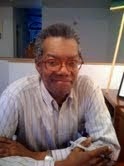
I heard about actor/choreographer Geoffrey Holder's death at the age of 84 during a radio newscast. (I think it was NPR.) Listening to his Paul Robeson-like deep voice (with a Caribbean flavor) as an excerpt from one of his 7-Up "Uncola" commercials was played, reminded me of the only time I got a chance to speak to him. It was at a Broadway revival of The Wiz (which he choreographed). This would be about thirty years ago. As I headed for my seat, I told him that I wanted to interview him. His odd response was, "Yes, but not right now." I never got to do the interview.
A few years later, I saw Holder and his wife, dancer Carmen de Lavallade, getting out of a car in the SoHo neighborhood of Manhattan. Our eyes met, but I kept on walking.
Showing posts with label Choreographers. Show all posts
Showing posts with label Choreographers. Show all posts
Thursday, October 9, 2014

Saturday, February 8, 2014
Letting Dancegoers Interpret The Dance For Themselves
In April of 1989, avant-garde dancemaker and former architect Gus Solomans, Jr. collaborated with a team of Columbia University students in the creation of a dance work called Site Line, performed by members of the Solomans Company/Dance at the Danspace Project of St. Mark's Church in Manhattan's East Village. In a telephone interview, Solomans described the work as a dance with "a wall that would divide the dancing space in half. The audience on each side of the wall [will] see essentially a different dance. They'll be able to see the dancers on the other side. The wall is partly transparent, partly translucent, and partly opaque." Solomans said that he wants the audience to interpret what they see for themselves,"to make choices, to participate as viewers, not just sit there and [let the choreography] wash over them and be entertained. I try to make the visual atmosphere rich enough to get some stimulation."
In another dance work, performed at Danspace in January of 1990, Solomans's company presented a piece for five men whose title was represented by a symbol described by Solomans as "an unpronounceable graphic gesture." Both the dancers and the musicians provided vocal sounds. And as with Site Line, the audience was expected to interpret for themselves what the vocal sounds and movement signified.
This article was originally published in the New York Amsterdam News. It was edited from two articles that were published in 1989 and 1990.
In another dance work, performed at Danspace in January of 1990, Solomans's company presented a piece for five men whose title was represented by a symbol described by Solomans as "an unpronounceable graphic gesture." Both the dancers and the musicians provided vocal sounds. And as with Site Line, the audience was expected to interpret for themselves what the vocal sounds and movement signified.
This article was originally published in the New York Amsterdam News. It was edited from two articles that were published in 1989 and 1990.
Monday, January 6, 2014
Creating Choreography Via Architecture
Avant-garde dancemaker Gus Solomans, Jr.'s segment will be half of a shared evening of dance at the Danspace Project of St. Mark's Church in [Manhattan's] East Village (April 14, 15,16 [1989]). In a collaborative work with a team of Columbia University [architectural] students, the Solomans Company/Dance will present Site Line, described by Solomans (a former architect), in a telephone interview, as a dance with "a wall that would divide the dancing space in half. The audience on each side of the wall [will] see essentially a different dance. They'll be able to see the dancers on the other side. The wall is partly transparent, partly translucent, and partly opaque." Solomans says that he wants the audience to interpret what they see for themselves, "to make choices, to participate as viewers, not just sit there and [let the choreography] wash over them and be entertained. I try to make the visual atmosphere rich enough for everyone to get some stimulation."
This article was originally published in the New York Amsterdam News (April 15, 1989) as part of a Spring 1989 Dance Roundup article.
This article was originally published in the New York Amsterdam News (April 15, 1989) as part of a Spring 1989 Dance Roundup article.
Saturday, January 4, 2014
Choreographer Donald Byrd's Future Plans
Donald Byrd, 40, who "had always wanted to [dance]" but got started late (in his late teens), formed his own dance company--Donald Byrd/The Group--in 1978 in Los Angeles where he decided to stay after touring there as a member of Gus Solomons, Jr.'s company. Five years later, he made the move to New York because L.A. had "no sense of community, no support for the arts. I felt isolated from other people, from other artists."
Since then the North Carolina-born, Florida-reared choreographer's critically-acclaimed, issue-oriented dance works have been set on companies such as the Alvin Ailey American Dance Theatre (which premiered Shards last year at the City Center [in New York]) and the Minneapolis-based Zenon Company.
Also a teacher, Byrd hopes to build a school and performance space through the Donald Byrd Foundation, established in 1985, as a way for him to repay the theatre world "which has given me a lot." He sees the school as "a place where kids can come in and do the kind of work that I see is important work."
Shortly before a one-week tour of Hungary and Yugoslavia, Donald Byrd/The Group performed a children's program on August 11 [1989] at the Harlem School of the Arts. They will next participate in the Black Choreographers Moving Toward the 21st Century dance festival scheduled for San Francisco (November 1-12) and Los Angeles (November 12-19). [These were 1989 dates.]
This article was originally published in the New York Amsterdam News (November 25, 1989).
Since then the North Carolina-born, Florida-reared choreographer's critically-acclaimed, issue-oriented dance works have been set on companies such as the Alvin Ailey American Dance Theatre (which premiered Shards last year at the City Center [in New York]) and the Minneapolis-based Zenon Company.
Also a teacher, Byrd hopes to build a school and performance space through the Donald Byrd Foundation, established in 1985, as a way for him to repay the theatre world "which has given me a lot." He sees the school as "a place where kids can come in and do the kind of work that I see is important work."
Shortly before a one-week tour of Hungary and Yugoslavia, Donald Byrd/The Group performed a children's program on August 11 [1989] at the Harlem School of the Arts. They will next participate in the Black Choreographers Moving Toward the 21st Century dance festival scheduled for San Francisco (November 1-12) and Los Angeles (November 12-19). [These were 1989 dates.]
This article was originally published in the New York Amsterdam News (November 25, 1989).
Tuesday, December 31, 2013
Dance Theatre Of Harlem At New York's City Center
As part of Dance Theatre of Harlem's 20th anniversary celebration, an all-Nijinska program has been scheduled for four evenings during the company's two-week engagement at City Center (June 21-July 2 [1989]).
These evenings will offer dancegoers the unique opportunity of seeing three Bronislava Nijinska ballets performed collectively; a first for an American company.
Although DTH has previously staged Les Biches, Les Noces and Rondo Capriccioso will be company premieres.
"When we did Les Biches five, six years ago," recalled artistic director/co-founder Arthur Mitchell, "Irina Nijinska"--the daughter of one of the greatest choreographers in Serge Diaghilev's Ballet Russes company--"said 'You know, I think it would be wonderful for the company to do Les Noces' and I said 'It's a nice idea.' This year her mother, who is the sister of [the late dancer/choreographer ] Nijinsky, is celebrating her, some say 98th; some say, 99th; some say, 100th birthday. I thought it would be a wonderful tribute [to her] to do that whole evening."
In addition, continued Mitchell, these works reveal "the diversity and the strength of the company" as well as providing balance to the repertoire by giving the audience "something historic and then something new."
One of the ballets--Rondo Capriccioso--has not been performed since its 1952 premiere. This season will mark its American debut.
Fortunately for DTH, Rosella Hightower, who originally danced the part of the Bird of Paradise, and, said Mitchell, "is one of the five great American Indian ballerinas," was able to reconstruct from memory the ballet, "a small piece for four people" that, further stated Mitchell, "even Nijinska's daughter didn't know [about]." Interestingly, she is the only ballerina to ever dance the role. (This time around, Stephanie Dabney, a DTH principal dancer, will be the new Bird of Paradise.)
Other ballets include Mitchell's John Henry, set to music by Milton Rosenstock, Dance Theatre's musical director and Balanchine's Allegro Brilliante, built on music by Tchaikovsky.
This article was originally published in the New York Amsterdam News (June 24, 1989).
These evenings will offer dancegoers the unique opportunity of seeing three Bronislava Nijinska ballets performed collectively; a first for an American company.
Although DTH has previously staged Les Biches, Les Noces and Rondo Capriccioso will be company premieres.
"When we did Les Biches five, six years ago," recalled artistic director/co-founder Arthur Mitchell, "Irina Nijinska"--the daughter of one of the greatest choreographers in Serge Diaghilev's Ballet Russes company--"said 'You know, I think it would be wonderful for the company to do Les Noces' and I said 'It's a nice idea.' This year her mother, who is the sister of [the late dancer/choreographer ] Nijinsky, is celebrating her, some say 98th; some say, 99th; some say, 100th birthday. I thought it would be a wonderful tribute [to her] to do that whole evening."
In addition, continued Mitchell, these works reveal "the diversity and the strength of the company" as well as providing balance to the repertoire by giving the audience "something historic and then something new."
One of the ballets--Rondo Capriccioso--has not been performed since its 1952 premiere. This season will mark its American debut.
Fortunately for DTH, Rosella Hightower, who originally danced the part of the Bird of Paradise, and, said Mitchell, "is one of the five great American Indian ballerinas," was able to reconstruct from memory the ballet, "a small piece for four people" that, further stated Mitchell, "even Nijinska's daughter didn't know [about]." Interestingly, she is the only ballerina to ever dance the role. (This time around, Stephanie Dabney, a DTH principal dancer, will be the new Bird of Paradise.)
Other ballets include Mitchell's John Henry, set to music by Milton Rosenstock, Dance Theatre's musical director and Balanchine's Allegro Brilliante, built on music by Tchaikovsky.
This article was originally published in the New York Amsterdam News (June 24, 1989).
Monday, November 19, 2012
Assessing The Dance World
In assessing the current New York dance scene, the four dance experts I interviewed saw very little, if any, trendsetting going on in modern dance or ballet.
The leaning in modern dance toward what Celia Ipiotis, the host of Channel 31's Eye on Dance, described as the blending of "elements from the world of theatre, music, and visual arts" is, said dance historian Joe Nash, "nothing new. Everything now is merely a continuation of what was started in the sixties." Although there is this cyclical aspect to modern dance, Village Voice critic Deborah Jowitt pointed out that "whenever those things come out, they usually come back in a slightly different form."
Back in the sixties, recalled Jowitt, there was "a dance revolution" that took place. It was at this point, said Nash, "when modern dance entered a whole new phase." What the early pioneers such as Martha Graham and Katherine Dunham "established [was] a style, a technique, an approach to modern dance that was related to [a period] when people were trying to communicate about issues, about the human spirit." But, further explained Nash, who teaches dance history at the Alvin Ailey school, the choreographers who emerged from the Judson Movement in the sixties--named after the church performance space on the West Side of Manhattan--wanted to "establish their own principles of movement that ran counter to what was considered traditional. It gained in popularity as more people entered the field. Critics began to try to analyze and describe what they were seeing. They still don't know what they're seeing, but they describe it anyway."
In ballet, particularly with "the major companies," said New York Daily News critic Charles Jurrist, "it is really hard to spot trends." Jowitt attributed this to "the classical language staying the same." She detected, although, "a kind of aggression entering ballet. You can see a lot of aggressive, violent dance today in ballet and contemporary dance."
Said Jurrist, "The New York City Ballet has clearly still not decided where it's going after the death of [its founder and choreographer George] Balanchine. At ABT [American Ballet Theatre], they've mostly been involved in cleaning up the company which needed a lot of cleaning up--disciplining the corps de ballet and sort of weeding out the repertory, making it a more stylistically coherent company." Jurrist added that he "really couldn't say that I would spot a trend in either one of those two companies--as yet."
On the other hand, historian Nash saw the influence of modern dance, particularly the African American contribution to it, on contemporary ballet. "At the root of American dance is the black movement styles. What the African American brought to a whole field of dance was just total involvement of the body in dance. You now see twisting and contorting the body as you would do in jazz or ethnic dance. This is the contemporary trend. Contemporary ballets are really based upon the New Movement as opposed to classical tradition handed down from the 17th century--'Swan Lake', 'Giselle.' The choreographer takes those traditional five-position movements of the legs and arms and updates them and places them in a contemporary mold. More and more companies are using contemporary approaches to ballet production and that will continue."
Although Celia Ipiotis said that today the definition of dance is "fluid," the Daily News's Charles Jurrist thought that a lot of what passes for dance--such as "carrying a transistor radio onto the stage and turning it on"--should be labeled as performance art, which he himself admitted is a catchall phrase, much like the term "post-modern." In his mind, dance has "movement as its primary mode of expression. Otherwise, it's another form of theatre." Opined Joe Nash, "You will always have people engaged in multimedia because when you're lost for something to say through movement, you can always revert to words or [photo] slides."
This article was originally published in the West Side Spirit (December 19, 1988).
The leaning in modern dance toward what Celia Ipiotis, the host of Channel 31's Eye on Dance, described as the blending of "elements from the world of theatre, music, and visual arts" is, said dance historian Joe Nash, "nothing new. Everything now is merely a continuation of what was started in the sixties." Although there is this cyclical aspect to modern dance, Village Voice critic Deborah Jowitt pointed out that "whenever those things come out, they usually come back in a slightly different form."
Back in the sixties, recalled Jowitt, there was "a dance revolution" that took place. It was at this point, said Nash, "when modern dance entered a whole new phase." What the early pioneers such as Martha Graham and Katherine Dunham "established [was] a style, a technique, an approach to modern dance that was related to [a period] when people were trying to communicate about issues, about the human spirit." But, further explained Nash, who teaches dance history at the Alvin Ailey school, the choreographers who emerged from the Judson Movement in the sixties--named after the church performance space on the West Side of Manhattan--wanted to "establish their own principles of movement that ran counter to what was considered traditional. It gained in popularity as more people entered the field. Critics began to try to analyze and describe what they were seeing. They still don't know what they're seeing, but they describe it anyway."
In ballet, particularly with "the major companies," said New York Daily News critic Charles Jurrist, "it is really hard to spot trends." Jowitt attributed this to "the classical language staying the same." She detected, although, "a kind of aggression entering ballet. You can see a lot of aggressive, violent dance today in ballet and contemporary dance."
Said Jurrist, "The New York City Ballet has clearly still not decided where it's going after the death of [its founder and choreographer George] Balanchine. At ABT [American Ballet Theatre], they've mostly been involved in cleaning up the company which needed a lot of cleaning up--disciplining the corps de ballet and sort of weeding out the repertory, making it a more stylistically coherent company." Jurrist added that he "really couldn't say that I would spot a trend in either one of those two companies--as yet."
On the other hand, historian Nash saw the influence of modern dance, particularly the African American contribution to it, on contemporary ballet. "At the root of American dance is the black movement styles. What the African American brought to a whole field of dance was just total involvement of the body in dance. You now see twisting and contorting the body as you would do in jazz or ethnic dance. This is the contemporary trend. Contemporary ballets are really based upon the New Movement as opposed to classical tradition handed down from the 17th century--'Swan Lake', 'Giselle.' The choreographer takes those traditional five-position movements of the legs and arms and updates them and places them in a contemporary mold. More and more companies are using contemporary approaches to ballet production and that will continue."
Although Celia Ipiotis said that today the definition of dance is "fluid," the Daily News's Charles Jurrist thought that a lot of what passes for dance--such as "carrying a transistor radio onto the stage and turning it on"--should be labeled as performance art, which he himself admitted is a catchall phrase, much like the term "post-modern." In his mind, dance has "movement as its primary mode of expression. Otherwise, it's another form of theatre." Opined Joe Nash, "You will always have people engaged in multimedia because when you're lost for something to say through movement, you can always revert to words or [photo] slides."
This article was originally published in the West Side Spirit (December 19, 1988).
Subscribe to:
Posts (Atom)