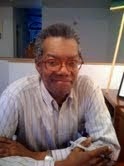
The following is from the transcript of my telephone interview in 1985 with the Harlem Renaissance writer and artist Richard Bruce Nugent (1906-1987).* He was also known as Bruce Nugent. Parts of the interview were used for an article I wrote about Nugent and the Harlem Renaissance for Joseph Beam's In the Life: A Black Gay Anthology.

Charles Michael Smith: It was hinted that [the poet Countee] Cullen and [Harold] Jackman [a schoolteacher] were lovers. It's hinted at in everything.
Bruce Nugent: You see, there was no such thing as a closet, particularly then [the 1920s]. It's just that nobody spoke about it. They didn't speak about quote heterosexual unquote relationships either. But people kind of knew. You don't get on a rooftop and shout "I slept with my wife last night" either.
CMS: You were considered the most flamboyant then.
BN: I've always been flamboyant. There weren't many black bohemians, I gather, at the time. I didn't wear socks I guess because I didn't have them sometimes. Sometimes because I didn't feel like it. Like today, I don't have on any socks. When I want to or when I think about it, I put on socks.
[He told me he was "very fond of the name Michael," my middle name.]
["I almost find it difficult to become friends with people who call me Richard."]
["I dabbled in everything," e.g. poetry, painting. "I've never been as diverse in my abilities as people are now. I didn't know music. I was just familiar with it, but I didn't know it. Popular music of the day, jazz, so-called classical music. Somebody asked me, 'Do you like classical music?' The first thing I said was 'No. Sounds stuffy.' And yet everything that was played at concerts I already knew because Mother and Father used to play it and sing it at home."]
[Wrote the gay historian Eric Garber: "...Nugent dabbled successfully in painting, drawing, poetry, and dancing. He was self-consciously avant-garde and often had no permanent address. Preferring to drift from place to place. Nugent spent much of his time drawing erotic, often phallic, drawings." (The Advocate, May 13, 1982.)]
["I thought everybody was in the life" if he thought they were attractive. He was involved in a three-way fuck with Philander Thomas, who was "classically good-looking. By classically I mean that in Africa he would have been a classically beautiful person. What they didn't know then was that Africans frequently had features like that, aquiline, Caucasian features. He was quite, quite beautiful. Philander didn't do anything. [He was] very much a playboy. He brought people together. That's what he liked to do. Not a matchmaker in that sense, but bedmates. [People who came to Harlem did so] to vent their pleasures and Harlem was the place to be and everybody thought they could, and Philander saw to it that they did.
CMS: Did Philander have a sense of humor?
BN: Oh, yes [said with pleasure in his voice]. He was quite a man, quite a funny man. I loved Philander. I liked his random freedom. Real freedom. Very few people have it. I had it.
CMS: Do you know where Philander Thomas came from?
BN: I know very little about anybody's background. Apparently that's a failing of mine.
CMS: Did Philander live in Harlem?
BN: Oh, yes.
CMS: He didn't work for a living. He more or less put people together.
BN: He put together homosexual people. He liked to do it and I suppose it was a time when people made their money any way they could. [Nugent said Philander Thomas was "truly named."]
CMS: Was he an actor?
BN: Oh, yes.
CMS: How did you meet him?
BN: I met him in Porgy [a play based on the novel by DuBose Heyward. The play became the basis for Porgy and Bess by George Gershwin and his brother Ira]. He was much more outgoing than I.
CMS: What did you do to amuse yourself?
BN: Go to shows, go to parties.
CMS: How did gay men meet then?
BN: I'm always kind of thrown by that question because it seems to me people just meet people. Like it is now. I understand that there were gay bars, gay places. I never patronized [them] because I was not fond of the company of gay people. I still don't enjoy their company very much. They don't have anything to talk about.
["If I had a place of my own, I would much rather be the host than the guest. That's still true." He goes to parties, but "They're not my favorite form of entertainment." "I've never been one to gravitate towards gay bars, gay restaurants, gay this, gay that. Any more than I've wanted to go to black this, black that. I go to people bars.]
CMS: Was Langston Hughes a gay man?
BN: I have strange feelings about Langston as well as I knew him. And it has been said that except for [writer] Arna Bontemps, I was Langston's best friend. Certainly, I knew him longest. My personal feelings about Langston is that he was asexual. I had a big argument with Faith [Berry, a Hughes biographer] after that. She implied that he was homosexual. I said to her, "How do you know that?" As long as I've known him, I didn't know that. He had a longstanding friendship with a boy named Zell Ingram. There were people who felt that Zell and he were lovers. I don't know whether they were or not [sleeping together]. A lot of those kinds of things weren't important to me. I know it was unimportant to Langston what people thought about them.
CMS: Was Zell gay?
BN: I don't know.
CMS: What about traveling?
BN: I love Italy. I go whenever I can, which is very seldom. I used to go every summer. There are caste differences in Italy. People are divided from each other in Italy.
[He still has an eye for the boys? "Of course I do. My only objection is they don't have the eye for me (laughs). I have to wait for those peculiar people who like older men. They are very few and far between."]
[His father "knew I was going to be gay." "One day we were playing checkers and I kept winning games. My father said to me, 'It's time for me to die when you can beat me in checkers.' And he'd say, 'Never do anything you'd be ashamed of and never be ashamed of anything you do'."]
[He got married in 1953; 17 years (length of marriage); his wife died of cancer; "My love [for her] wasn't a physical love."]
[He was part of the staff of the short-lived magazine Fire!! as well as Harlem.]
CMS: You wrote "Smoke, Lilies, and Jade" for Fire!! It is considered the first short story to deal with black homosexuality.
BN: People began to say, "How could you write anything so gay in 1926? I didn't know it was gay when I wrote it.
CMS: The protagonist seemed to be bisexual. He was not an exclusively gay man. At the time you wrote the story, a lot of people were scandalized by it.
BN: He called the man beautiful, and I did it. I even named one Beauty.
CMS: You were rejected for a couple of days.
BN: I don't think they rejected me. I just think they were a little shocked and scandalized.
CMS: Why so many ellipses in "Smoke, Lilies, and Jade"?
BN: It was my device for having people [get the impression] that I was talking with them. When you talk, you have these periods, shorter and longer periods. It wasn't originally written with three dots between everything. Now three dots, now five dots, now two dots. But the printer said, "We can't be bothered with doing that. We don't have that many dots." I would still like to do it sometime with the proper dots.
CMS: You did it deliberately to shock the middle-class people.
BN: Wally [Thurman] and I thought that the magazine would get bigger sales if it was banned in Boston. So, we flipped a coin to see who wrote bannable material. And the only two things we could think of that was bannable were a story about streetwalkers or prostitutes and about gay people, homosexuality.
CMS: Thurman was a gay man himself and he had a problem around that.
BN: Oh, God. Everybody did.
CMS: He more so.
BN: Wally was a deeper thinker than I was. I didn't think very much. I wasn't a very cerebral person.
CMS: Was he fun to be around?
BN: We lived together. You don't think I'd live with somebody who wasn't fun to live with. Yes, Wally introduced me to so many, many, many facets, things. He was very widely read and that's all I can say about him. He was absolutely a fascinating person. And perhaps with the exception of maybe one person, George Schuyler, who was more brilliant than he.
The Blacker the Berry [Thurman's novel] is pretty bad. He wasn't a very good novelist. You have to be your characters when you write a novel. He tried to be a woman.
CMS: He was writing about himself.
BN: He was ambivalent about his color. He grew up in Salt Lake City, that Mormon place. I was from Washington, D.C. and in Washington, we didn't associate with people who were as dark as Wally. And Wally was pretty black. My description of him [in David Levering Lewis's book, When Harlem Was in Vogue]: black with a sneering nose. He was very self-conscious about being black.
CMS: Was he effeminate?
BN: He was not. As a matter of fact, when we were living together, people thought quote that he was the husband, and I was the wife. I'm sure they thought that. I was the one who had the gay reputation. People put their own interpretation to anything.
CMS: His novel, Infants of the Spring, was autobiographical?
BN: That was almost all autobiographical. I think he was more successful in that [novel].
CMS: You say your marriage was not a physical love.
BN: We were very much in love with each other. I spent two years trying to prevent her from marrying me because she was definitely a heterosexual woman and a very beautiful one. Men were after her all the time. I told her [I was gay] but I suppose she had that dream that makes them think they can change me. Gayness is just a phase, an adolescent phase, you outgrow it. [No children were produced from the marriage.] Anybody, people who saw us together at that time never would doubt why we married. We were so much in love. Taxicab drivers would stop [and say] "Were you flagging a cab?" We'd say, "No!!" So, he said, "Where are you going, I'll take you. I've never seen people so much in love."
CMS: When did you know you were gay? At age 12, 13?
BN: I discovered that I liked men long before that. Seven, eight, nine, before I had any sexual experience at all of any kind. There used to be a man, a Filipino. There's a strong prejudice as you probably know among American Negroes toward anything that's not American Negroes, be it African, Filipino, Puerto Rican, whatever. This boy's mother was not accepted into Washington Negro society. Mother befriended him. I was very fortunate in my parents. The only word for them was that they were bohemians. My mother played piano; my father sang. Mother played by ear. She was invaluable when [the mixed-race British composer Samuel] Coleridge-Taylor came to America. No one could play his music. Coleridge-Taylor's music was too complicated and too much very sundry other things. I remember Taylor would come past the house and talk with Mother and he would hum it [his music] for Mother and Mother would play it. Later on, she learned to read music, but at the time she didn't. So when [John Philip] Sousa's band couldn't play the music, my mother accompanied them.
I came from a middle-class Washington family. My mother studied to be a schoolteacher. She never taught. My father was a Pullman porter. It was very respected; one of the few ways to make money. At that time [his parents] were pillars of society in Washington, which meant fair [in complexion], quote good hair, all the other bullshit. As a matter of fact, it was because of all that crap that I left Washington.
CMS: Why did you move to Hoboken [in New Jersey]?
BN: I couldn't afford to live in New York. [He has lived in Hoboken for seven or eight years.] I have a habit of living wherever I happen to be.
CMS: What do you do now in your spare time?
BN: I still write and draw. I get Social Security and brunches on the goodwill of my friends.
Nugent spoke at a gathering of the members of Black and White Men Together/New York. He told them, "If you don't have the courage of your convictions, nobody is going to be able to give it to you. If you don't have enough love to share, you're not going to get it. You can't love anybody else if you don't yourself because what are you loving from? I've always felt like this. This is probably what makes me a bohemian. It's probably going to keep me alive another seventy-some years. If you can't take me the way I am, it's your problem. It's certainly not mine."
*Three artworks by Nugent, including a self-portrait, are on display at New York's Metropolitan Museum of Art in a show called "The Harlem Renaissance and Transatlantic Modernism." It closes on July 28, 2024.